
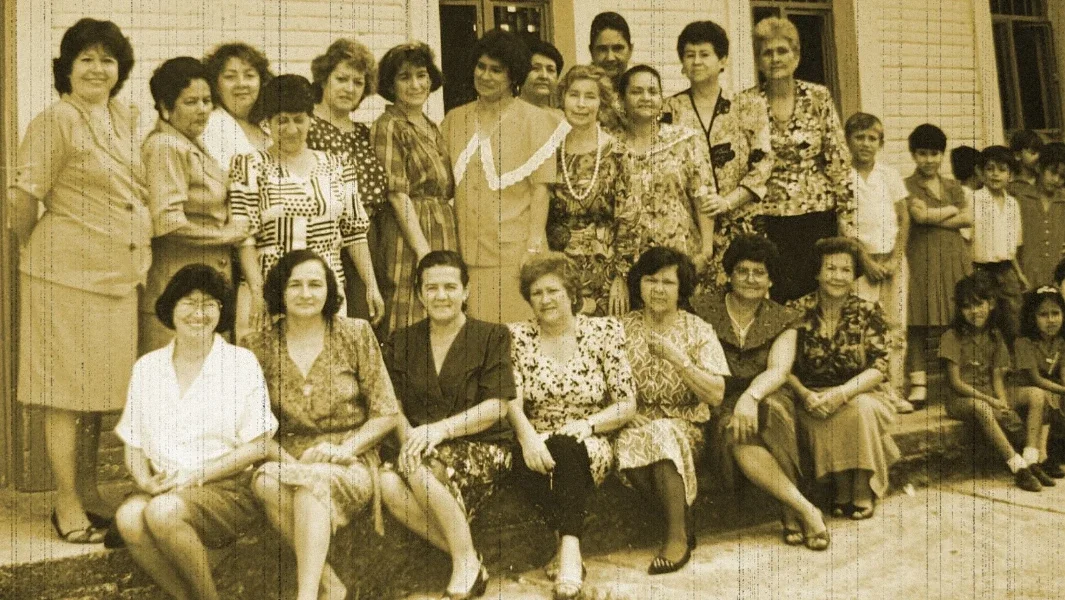
In 1970, the city of Ibagué was preparing to host the 9th National Athletic Games, and the Territorial Credit Institute (Instituto de Crédito Territorial) spearheaded the creation of a facility to house the athletes participating in the event. The facility was located at the intersection of Carrera 5 and Calle 69, in Block 12 of the Sixth Stage of the Jordán neighborhood. Following the conclusion of the sporting event, residents from the various stages of the Jordán neighborhood petitioned government authorities to donate the premises. Their goal was to establish a school to provide education for the many children in the area who were not currently attending school. The request was granted, leading to the opening of a new school in Ibagué: the Misael Pastrana Borrero School. The school began with 560 students—divided into two shifts—and 18 teachers. Its first principal was Juvenal Arias, who was succeeded by Nibardo Carrillo, followed by Afranio Paramo; each served as the sole principal overseeing both shifts.
In 1975, the school operated under two separate administrations: one for the morning session, led by Gioconda Caminos de Carvajal, and another for the afternoon session, directed by Maximiliano Buendía. In 1976, the need arose to establish a preschool program, and in 1984, a dedicated classroom was prepared for this purpose; that same year, the administration of the afternoon session was delegated to Luz Marina López de Díaz. In 1988, "Nucleus No. 6"—known as "Los Pijaos"—began operating on the institution's premises. Its first director, Martha Brígida Rojas de Vera, served until 2001, when she retired and was succeeded by the current head of the nucleus, Leonel Torres (who holds a specialized degree). In 1994, at the request of the educational community, the institution's name (or official designation) was changed. The morning session was renamed "Centro Escolar Los Arrayanes"—approved by the Municipal Council under Decree No. 000602, dated June 29, 1994—while the afternoon session was named "Instituto Docente Beatriz Gómez de Pérez," pursuant to Decree No. 000941 of 1994, issued by the Municipal Secretariat of Education.
On April 6, 1998, a computer lab was equipped with 12 computers, purchased by the educational community from both the morning and afternoon sessions, while in 1999, a room was adapted to serve as a biology laboratory. That same year, the Department of Education appointed Ms. Luz Dary Triana as the first authorized secretary. The studies offered during the morning session—covering preschool, primary education, and secondary education (grades one through eight)—were officially recognized through Resolution 1477 of November 19, 1998; the afternoon session was recognized via Resolution 1435 of November 17, 1998. Under Resolution 1179 of November 26, 1999, the educational institution was officially recognized for its preschool, primary, and secondary education levels, in compliance with the requirements established by Decree 1860 of August 3, 1994. In 2002, the "Beatriz Gómez de Pérez" Adult Education Center (night session) was merged with the "Los Arrayanes" Teaching Institute in the Municipality of Ibagué, pursuant to Resolution No. 0088 of January 30.
Through Resolution 7102440 of November 23, 2011, the educational institution received official recognition for its preschool, primary, and secondary education levels, as well as for adult education cycles II, III, IV, V, and VI, in compliance with the requirements established in Decree 1860 of August 3, 1994, and Decree 3011 of December 19, 1997. In 2012, the Secretariat of Education appointed Fabiola Jiménez Cabrera as the first coordinator for the afternoon session, thereby providing the educational institution with a total of two (2) coordinators. On October 1, 2012, the institution acquired 30 laptops—provided by the "Computadores para Educar" (Computers for Education) program—for the Juliana Velandia computer lab, along with an additional 10 laptops for the informatics lab. Beginning in 2013, through the efforts of its principal, Elizabeth Patricia Gallo Bohórquez, the educational institution established a children’s marching band, which has distinguished itself through performances at various cultural events both inside and outside the institution. Through Resolution 710003122 of November 17, 2014, the educational institution received official recognition for its preschool level.
Since 2016, the educational institution has participated in the "SUPérate" games in the disciplines of youth soccer and futsal (indoor soccer). In 2018, it became the municipal, departmental, and regional (southern zone) champion, and in 2019, it achieved the titles of municipal, departmental, regional (south-central zone), and national champion. Also starting in 2016, under the leadership of the principal, Santiago Prada Prado, the institution established inter-institutional agreements to effectively prepare upper secondary students (grades 10 and 11) for the SABER 11 standardized test. This initiative led to improved test scores and a higher Synthetic Quality Index, resulting in the institution being classified as "HIGH" (ALTO) by the Ministry of National Education (M.E.N.). In 2016, an academic high school program with an emphasis on Natural Sciences was approved; this allows students to pursue extracurricular activities—such as sports, music, art, and singing—during the hours outside of their regular school schedule, according to their personal interests. Furthermore, as of 2016, the Municipal Secretariat of Education—taking into account that the "Joseista" educational community serves students with disabilities and specific needs...
The institution’s staff includes 39 teachers, 5 administrative personnel, 2 coordinators, 1 guidance counselor, and a principal. Currently, it provides educational services—covering preschool, the nine grades of basic education, and the two grades of upper secondary education—across 35 classes, serving approximately 920 students. Additionally, the institution offers an adult education program (CLEI) during the evening shift, organized into five groups across cycles III, IV, V, and VI. For the first 50 years of its existence, the institution utilized classrooms that were originally dormitory spaces, each with a capacity for 30 students. Given this situation, the Municipal Secretariat of Education decided to include the institution in the Ministry of National Education’s (MEN) "single-shift" (extended school day) program and the Financial Fund for School Infrastructure (FFIE) project for the construction of new facilities. The demolition and construction process is currently underway; consequently, the Secretariat of Education authorized a relocation to the former premises of the Juan Lozano y Lozano Educational Institution—a site that lacks the optimal biosafety conditions for classrooms and sanitary facilities required in light of the current emergency.